6.11.2010

Moz, Part 4: Driving from North to South


The road from Pebane back to Kwa-Zulu Natal is long. The roads are poorly maintained with enough pot-holes to kill a normal rim in an hour. Lucky for us, in our big-manned Land Cruiser (vehicle of Africa) we only had rattled bellies and brains, but the vehicle was fine! We traveled from Pebane to Inchope the first night. From there we drove solidly to Vilankulos and then on to Praia de Tofo (near Inhambane). Our last long drive was to Maputo and from there back to Pongola. All in all, 5.5 days of driving, sleeping, and swimming.

We saw stacks of people all the way down -- there is nothing such as the "wilderness" in Africa, truly there are people everywhere. My photos are poor because of the road conditions & my difficulty to focus through the windscreen. However, take them for what they're worth! The last two photos I co-opted from another website, as I ran out of camera battery 1/2 way down!


I took notes on the drive down. They are as follows:

Pebane to Inchope:
* crippled man with a rock tied to his write to keep spasms in his hand still; big smile on his face; always walks up and down the road, the happiest guy, Johannes says

* kids selling live chickens - holding legs, flapping wings, struggling for freedom whilst being held out over the road.

* bikes laden, used as modern day wheelbarrows with racks full of: pineapples, sacks of charcoal, sides flanked with wooden planks

* African women walking an extra head tall with the following atop: sticks, sacks of maizemeal, bundles of mandioca/cassava - wrapped in patterned cloth, bundles of firewood, plastic jugs of water, plastic bins with fresh laundry (washed in the river)

* bikes with 2 or 3 passengers, often a mamma with child side-saddled on the back.


* streets littered with rows of children, girls in dresses -- no uniforms here, too poor, tattered school books carried in one hand; can see that there aren't enough schools in rural areas by the #s of children you see during the school day.

driving to Maputo from Praia de Tofo:
* baobab groves, magical; planted fields where they've left the large trees to stand in the middle; towns that have grown up around the baobabs, much like in that new film Avatar

* goats & rooster tied to wood-laden trick, cowering as nestled close to wood, bodies quivering/trapped.

* old school buses over-loaded, sometimes almost twice as tall with loads of luggage & coconuts mounted in bundles on top. major safety hazard!


* Johannes speaking Portuguese, feels like a remarkably familiar language because of my French/Spanish: mar, por favor, senora, etc.

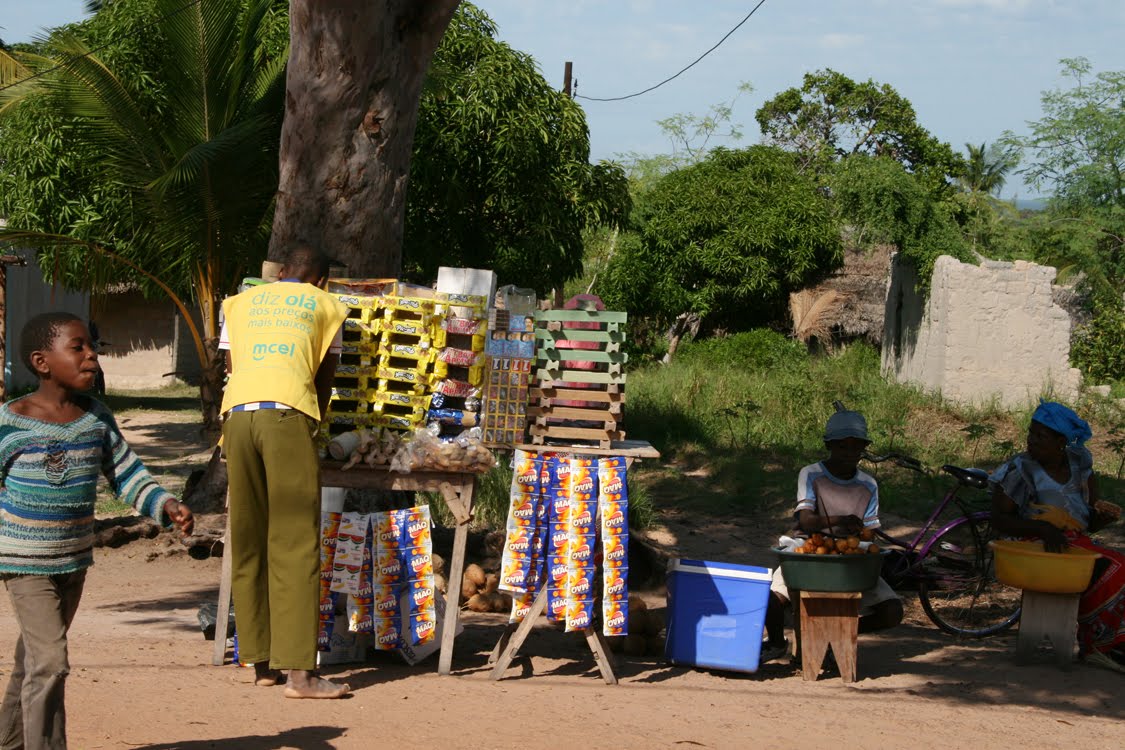
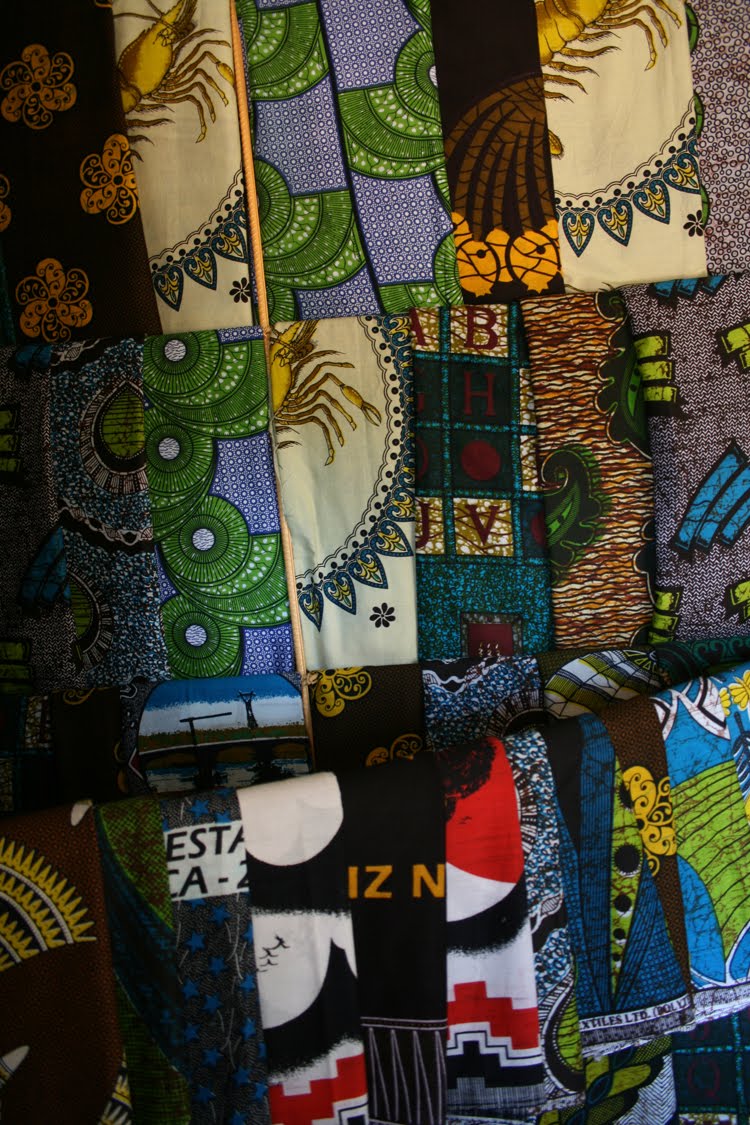
* for sale on the sides of the roads, north to south: reed mats, baskets all shapes and sizes, charcoal, honey, diesel, coconuts + scraper tools, fabric, clay pots + urns + bowls, guavas, traditional beer, maize mortar & pestles made from large wood pieces, cashew nuts being flown from trees in clear plastic bags, charcoal burners, chickens live, exotic birds, thatch chicken houses -cute, wooden planks, reed bundles, hats, wooden sculpted fish, doors, chairs, stick bundles for building, live goats, metal buckets, concrete tiles with holes to be used as windows, second-hand clothes


* Maputo - throngs of people; markets, ladies sitting with spreads of lemons & tomatoes on blankets and what looks like collard greens -- me sitting on the back of bakkie to protect our worldly goods from quick-handed theft

* mosques up north; old-style Portuguese churches in south

* prawns, prawns, prawns

* women becoming more modern as we drive south, some with jeans and fancy hairstyles & contemporary fashions; compared to north where they wear traditional patterned cloth, often 3 pieces, one wrap for skirt, one wrap for torso, one wrap for head.

* fabric traditional women wear changes as we go south, too -- less of the blue/green/white/black patterns from Malawi; more 2-toned plaids


Images from Vilankulos & Praia de Tofo will be removed at the request of the owners:
http://mocambique3.blogs.sapo.pt/arquivo/VILANKULOS%20-%20vista%203_resize.jpg
http://macua.blogs.com/photos/turismo/tofo1.jpg


6.10.2010

Moz, Part 3: Pebane, Moçambique


While Pebane (peh-bah-nee) is a speck on the map, like most African towns, it is still full of people. Its position by the sea makes it a lucky town, with its free share in fish-capture, however there aren't many other reasons to mark Pebane from the other small towns I saw with Johannes.

We went to market on a Saturday, though there's always a market everyday when a town lacks a grocery store! The market consists partly of 3-walled stalls with thatch roofs where people daily stock their goods; partly of floor mats and chairs lining the streets; and partly of small, free-standing wooden rooms, such as you see in my photo of the man folding my fabric, for vendors with pricier stock. In such rooms (also called tuck shops) you can also buy various sundries, like long-life milk, cooking oil, beer, cigarettes, soap, and airtime for cell phones. There's not much refrigeration in Pebane, obviously due to the recent electricity installation, so there are few things you can buy cold: coke, fanta and beer. No butter, no yogurt, no fresh milk, and certainly no ice cream!


The hustle and bustle in town was lively, music playing on tin-ey sounding radios, clunky steel bikes bobbing over the bumpy roads, and a mixture of Portuguese and the local Bantu-dialect being spoken loudly. Items for sale included: peanuts, cassava root, eggs, live chickens, green beans, patterned fabric, potato chips, knock-off American brand clothes and lumps of second-hand clothes. Also, a common site, amongst many of the towns we saw, were small bicycle stalls under grass roofs, where men congregated over fixing a motley crew of bikes.

In this town, transport is limited to foot and bike. Occasionally a large truck passing through will fill its back to the brim with people as a way of mass transport from town to town. Otherwise, the people stick to their local regions and I doubt they ever travel more than 60 kms from their homes, ever. When your main priorities consist of carrying water from the closest bore hole to providing food for your family, there is very little time left over to dedicate to travel. It makes rush-hour traffic lines in Chicago, New York and Johannesburg seem like light-years away. Life is slow-paced and only the necessary projects are accomplished. This gives way to the slow hips of the women who walk with 40-litre water containers on their heads, deliberately placing each footstep in a rhythm known only to these. It gives way to the long, patient minutes devoted to eating pap (maize-meal) and cassava with fingertips, slowly soaking up the fruits of a day's labour and the juices of the day's meal.

Other than the normal hum-drum of daily life, we were witness to a rare spectacle passing through Pebane. The Moçambiquan president was coming to visit! As such, the day we arrived, we saw rows of people with pangas (machetes) and hoes in hand, hacking at the grass surrounding the sand roads & ensuring the road would provide a smooth ride (ha, ha!). Children were let out of school early to help in the effort and you can see this as well in one of my photos posted here. One day, while driving along the beach, we came across the procession of the president coming to visit a local celebration in his honour. Note, we were not invited and not wanted & we left quickly! But, for a millisecond, I heard the flavor of the local music; very African in it's rhythm, with something of Europe mixed in with the Portuguese language.


After driving from north to south in Moçambique, I must say that Pebane was special in that white people are a rarity, ie they know little about white people and that they stand for money "only," as is often the impression on this continent. Therefore, the local black population seemed to stare and gawk, rather than flock and hassle. They kept a respectful distance, maybe calling out "whitey" in the local tongue. When Johannes jovially broke out in Portuguese, however, they were all shocked to silence!


Some people remembered Johannes in town, but more so along the coconut-shell paved roads (the coconut shells provide a buffer from the difficult sand) where stacks of children ran out of their houses calling, "Ta-Ta (hello)! Johanne-see! Johanne-see!" All the children along the road to the lodge remember Johannes with affirming affection from the days when he lived there and handed out sweeties daily. It was quite endearing to hear! You can see in one of my photos the clean, sand yard of a clay-brick house -- all the houses are kept as such, nary a hair out of place, hours given to sweeping the yard free of debris. Makes a grass yard a horse of a very different colour!


Moz, Part 2: Pebane Fishing Lodge


I had said 3 parts, but now there's destined to be 4. The following series includes photos taken of & from Pebane Fishing Lodge, where Johannes worked all of last year building furniture and where we resided for the week there. It's a private residence only used twice a year and is a phenomenal space consisting of raised platforms & walkways above the sand. All in all there are 4 huts -- 2 for living quarters with 4 bedrooms and 4 baths, plus 1 common hut with massive kitchen/lounge/dining areas, and 1 storeroom (which Johannes actually built).

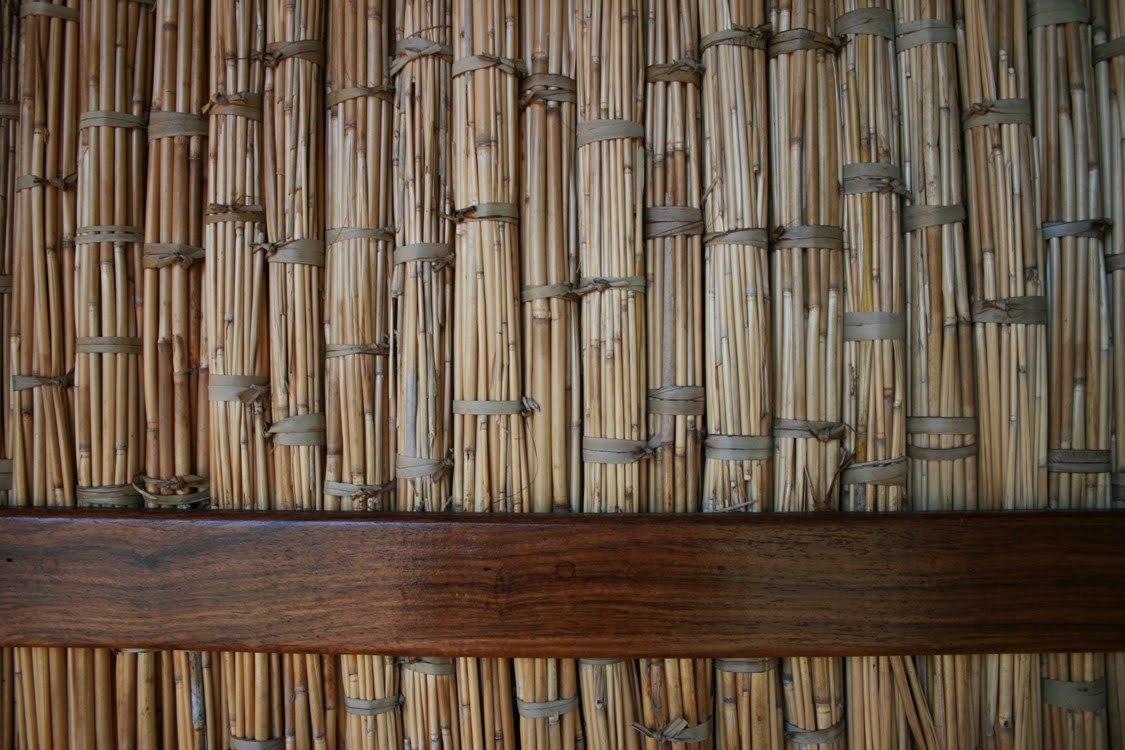
It's a beautifully built and designed lodge, using almost all local building techniques and materials. The roofs are made of woven mats of grass and the walls are made with carefully bundled reeds, 2 layers thick. Meanwhile, all the other fittings and furnishing are Grade A compared to anything the locals would enjoy, including 5 refrigerators, luxury showers, flushing toilets, satellite television, and an ice machine. The area of Pebane only received electricity 2 years ago, so most local housing still has yet to catch onto the 20th century way of life.

The local economy is barely driven by money. Fair trade is the word of the day as most local people live a life of subsistence. Chickens and goats, as in South Africa, are the insurance policy against drought and famine (I think the rooster call is the national anthem of Africa, by the way). The Portuguese left stacks of coconut palm farms and from that the people of Pebane derive much of their diet and building materials. The Portuguese also left behind some killer bread recipes, which seem a staple, although the flour is obviously purchased and not grown in sandy, dry Pebane. Cassava root, regionally known as Mandioca, provides starch. Peanuts and some type of green bean add protein, but the main stay of protein comes from fishing. Men fell large trees and from that they hack-out primitive canoes, which they row into sea every day for their catch. While I barely tasted any fish, I got windfall of loads of prawns, for which Mozambique is well known. Tiger prawns, peri-peri (chili) spiced prawns, cooked with the head on and all, prawns with chips, prawns with rice, prawns with coconut...am I beginning to sound like Bubba Gump of N'leans?


More photos to come in Part 3 of Pebane, the town.


6.05.2010

Mozambique, Part 1 of 3: From the Air


alt=""id="BLOGGER_PHOTO_ID_5479173498861591570" />


One of the coolest parts of my trip to Mozambique with Johannes was that we got to fly up in a private Caravan jet from Pretoria. This meant we flew much closer to the ground and were able to take, for the most part, unobstructed photographs.

The whole premise of our trip to Mozambique was for Johannes to do work there. Originally, Johannes met his Belgian bosses, Hans & Cherry, at their private Mozambiquan "Pebane Fishing Lodge" where he crafted all of their furnishings in 2008/2009. Cherry & Hans, who own the game farm we live on now, usually visit their private lodge/estate in Pebane a couple times a year. Pebane is far north in Mozambique, about level with the southern tip of Malawi, along the Moz coast. Bob & Mike, the farm managers, drive up in their Land Cruisers, taking fishing equipment, freezers full of food and extra supplies for the month-long stay. Meanwhile, Hans & Cherry usually go via private jet as it is an enormously long drive (2000 km/1250 mi) on roads in battered conditions, taking about 3 days in a Land Cruiser. Also, flying by plane means they can afford to take the nicest, freshest cheeses, produce and food stocks without the food spoiling. There is little fresh to buy up north, other than fish, prawns, coconuts, rice and Portuguese rolls.

The fact that Johannes and I got to fly up was simply a perk, because the plane was going north anyway to collect Hans & Cherry. Bob Potter & his wife Alet, also flew back to SA with the big guys, leaving the Land Cruiser behind for Johannes to complete his work & for us to jointly drive the 3 days back to SA. Luckily, however, they were gracious enough to leave a refrigerator stocked with fancy goats, parmesan, ricotta, feta and blue cheeses (unavailable even in Pongola!). In addition, they gave us several days to drive back so we didn't have to rush -- altogether we took 5.5 days to come back.

The trip by air was spectacular. You can see some of this from the photos, large masses of subsistance farms, age-old Portuguese palm tree/coconut farms, the crowded feel of the city of Beira, and the massive sand bars running along the coast. My 2 final photos in this blog are of our welcoming committee; one you can see above, 2 truck tops and a de-shelled building - the airport!, the other is of the locals who came to gawk at the bird from the air that landed on their airstrip (what I take to be as a very rare occasion.)

I have broken my Mozambique stay into three sections: 1) from the air, 2) the lodge & Pebane, and 3) the road trip home. Unfortunately, my camera battery went flat only 2 days into our road trip, so I don't have any photos to share of the idyllic places we stayed on the way home. However, our road trip home also coincided with our "breaking up" and I wouldn't have been very inspired to take photos, I must admit. Pictures of the sparkling blue ocean and frothy waves would only give the trip a glitsy visage, as opposed to the darkened one I was feeling the whole way home.


**Hans & Cherry's lodge comprise of the 4 thatched rooftops seen to the left in this photo, right along the shore.


6.01.2010

Crossing the Line

Imagine a day full of African border crossings, packing and repacking frozen prawns between coconuts and a freezer to avoid smuggling charges, only to return to a house with dead flowers bordering its walls, a freezer full of rotting meat and a tiled floor covered with 2-week old, congealed blood. Now to top this off, your relationship has met its end and, after countless days in a shared truck cab & small tents in steaming, hot Mozambique with happy-clappy tourists buzzing about sharing the love, you are home. The last thing you want to do is collaborate on cleaning out a death-sentence-evoking refrigerator, and yet you must. Yes, it's true.

Granted, all reactions to my sad news are acceptable. For now, I'd like to keep my explanations under wraps, for it's all a bit intense to be broadcasting this "live" online. Suffice it to say, my heart is sore, sore, sore. However, at the end of the day, Johannes and I are as different as day and night and for all that I embrace difference, it doesn't seem to create any healthy-functioning in our relationship as two very strong-minded people.

Now on to the interesting bit: what next? Obviously I cannot continue to live with Johannes, nor can I survive solo on my teacher's wages. I see that twisting mouth Grand-Dub, hoping I'll be bearing some good news....well, it is, but sadly not the sort grandmothers want to read. Over the last couple of months, in and amongst a whole process of trying to figure out how Johannes and I would ever truly "work," I have been offered an amazing job opportunity. The group I worked with in the Free State in 2008, Dramatic Need, actually approached me with the job opportunity to be their South African Project Manager. Thus, I have accepted and will be returning to Viljoenskroon in July to start my new job.

Two of my main jobs will include overseeing the construction and implementation of a new arts centre on the grounds of Rietpan Farm AND managing other volunteers from the UK and USA who come through to teach art. I will also be liasing with local communities, schools, and initiating adult education programmes. It's a job that combines my interests in art, organizing, youth, education and social justice -- something I've been imagining in my head for sometime, but unable to conceive as coming together in such fashion.

I've been busy making lists of Pros & Cons and trying to decided if it's time I returned to the old U S of A. While the country of my home weighs dearly on my heart, with all the people bound and wound in its arms, I'm excited for such a job opportunity to come my way and cannot let it pass me by. I hope another lengthy stay in SA will not further sever my ties with family, friends, and the hopes that I will someday return for good (I am going to try to be home xmas 2010!). All I know is that it is the right decision for me right now, given that I've been thinking it over the last two months.

Meanwhile, school runs another week and the World Cup bang will submerge South Africa in a delight of foreigners, vuvuzelas (loud horns used at games here), madhouse traffic and an extended school holiday. I will more than likely return to Cape Town in a couple of weeks to clear my head, grab my car, and move into my new slot in Viljoenskroon. It seems as though Johannes and I will part amicably. While in Mozambique, he also got the news that he will be working for the farm owners at their house in Belgium sometime in the next year. So in many ways, my moving to a new job and his opportunity in Belgium would have forged a natural split anyways. We both deserve to be happy, so I'm hoping we can go out with this easily.

In another blog later this week, I will give full details of Mozambique life plus photos....since I've now stepped into a school busy with exams, I'm going to be tearing my hair out over the next few days trying to stay afloat!!!

5.15.2010

Friday: from Dawn to Starlight


4:53 am: Alarm. Snooze once. Hear the drip, drip, drip of water falling onto the motorbike covering. Wake up, close door to bedroom, every where darkness outside, start the kettle, open the outside doors to let in the cool, chilly air. Lay out yoga mat, stretch calves and lower back for the 3rd time this week after 9 months of no practice. Begin running shower water, breathe some steamy, calcified water deep into my lungs and become more alert. Dry off, contacts in my eyes, lotion on my dry skin, swallow vitamins, dress, pour tea.

5:15 am: Settle onto bed in spare room, laptop on, tea in my right hand; finish creating examination for Grade 10 students sleepily leaning against the wall.

6:00 am: First light of day leaks over the horizon. The mist is thick with the trees creating an incomplete view of the hills beyond. The dew is dripping from the eaves in steady movement, splashing out puddles onto the tiled stoop. The giraffes are out, gnawing on the trees just beyond our front door. You can hear the impala bulls making a bellyaching, "ghaw" gasp from the bush (their usual morning wake-up call).


6:15 am: Wake up Johannes. Set out breakfast food. Quickly make lunch of Johannes' homemade seed bread with Mozambique honey.

6:25 am: Sit on the stoop steps with my yoghurt and another coffee. Listen to the loud chomping of the warthogs deep-throating their grass fodder and snorting as they walk along. They rustle the grass with every step and create a depth to the tall grasses of "what goes there?"

6:45 am: Oh, shoot, gotta go! Brush teeth, grab bags, open gate, wipe condensation off truck, and GO.


6:55 am: Make it to the outer gate and some curious local school children stare as I hop out to unlock, drive forward and close the gate.

alt=""id="BLOGGER_PHOTO_ID_5471426279302177586" />

7:05 am: Sibusiso's yellow uniform shirt peeks out from around the bend as I reach the Magudu turnoff. He hops in my car and says, as always, "Good morning Miss Sha-non. How are you?" An older man, sick with TB, approaches for a ride to the clinic. He hops in the back of the truck and off we go. Ride the rest of the way to school in general silence. Gaze at my favorite view of Pongola, just past the Zululand Nyala Lodge, where the rows of farms and their tree borders stack in rows, forming lines between the strips of morning fog, slowly withdrawing its opaque forces.

7:20 am: Arrive at school, along with all the other educators, just in time to hear the hand-held bell be rung by the appointed "Ringer." Students begin to form their lines, according to grade level, gender, and height. Someone in Grade 11 initiates a singing of the song, "Malibongwe" which means "praise." Students steadily stream in the school gates from the dirt road they walk until the whole school has more-or-less collected.

7:25 am: Ma'am Cele, with turban on her head and a shiny, whole expression on her face, begins her husky talks of God, "Xuloxulo." She sets down the wooden stick and trades it for a small, well-worn red Zulu Bible, from which she reads in her left hand. Meanwhile, her right hand attacks the air as she reads with steady, unwavering fervor, repeating sections for emphasis. End of her biblical streams of consciousness, students bow their heads in prayer, some holding a hand to their eyes as is customary here. She tells students "March in" and they go into their respective classrooms.

7:40 am: School starts, as usual, 10 minutes late. Sign in at reception. Gather books, chalk, walk to Grade 10A. Teach visual literacy, how to dissect an advertisement. Discuss marketing, target audiences, factual language and opinionated language. Show posters of “Romeo & Juliet” the film and students gaggle over the kissing figures in foreground.

8:30 am: Second period. Teach the same to 10B, but in a slightly improved way from first period.

9:30 am: Go to moderation cluster meeting with other Grade 10, 11, & 12 educators from the district. Supposed to share marked papers and moderate that each educator is marking fairly and appropriately. Head of cluster nominates moderation as waste of precious time and seeks approval from group to sign and date marked papers as “moderated” without actually moderating. Group agrees. We sign papers without moderating and the meeting finishes in less than 2 hours. The way of South African education.

11:30 am: Wors (sausage) rolls laid out in staff room in celebration of student teachers who leave today, during break time. Teacher Mathabela mocks my Zulu, while all other educators converse in Zulu.

12:00 pm: Planning periods for rest of the day. Print the exam papers I have written, in preparation for 2 weeks I leave to Mozambique. Make sure all assignments are laid out and ready for easy distribution while I’m away. Begin marking over 200 essays that were due this week.

2:00 pm: Bell tolls its final ringing of the day. Students spend the next 20 minutes sweeping their classrooms, stacking their desks and chairs, and mopping the staff room floor in preparation for the weekend. Students leave the school in droves and the educators are quick to follow, very few taking books home for the weekend. I leave with stacks of papers to keep me busy while I’m away.

2:45 pm: Drive to the local Traffic Department, for the fourth time in 2 months. Still attempting to cross the grey areas of my SA Citizenship and USA drivers license to become a SA driver. Take with me a ridiculous letter they required me to bring on my last visit, a letter stating why I was in the USA for 25 years and why I don’t have a SA license. Argh. Wait in line. Rudely, they ask me what I want when it’s my turn. They argue with me about putting the wrong address on the letter, which is irrelevant -- because now they want a letter from the US Ambassador detailing and legitimizing my USA license details. Argh again. So, so rude. Know that it’s because I’m white. Angry because I don’t own any of the racism expressed in this country.

3:15 pm: Give a lift to a woman who has just failed her drivers test into town. Drop her off and leave Pongola. Drive the 30 minutes home in silence and anger.

3:45 pm: Meet Mayoni at the gate, who is leaving the farm. He greets with “Sawbona, Enjani” and I respond with “Yebo, Si’apile.” He always has a huge smile that makes my heart sing. Depart the gate. I’m still angry and drive the last kilometer of dirt road trying to enjoy my surroundings and shake off the racism. Yes, there are my giraffes. Six of them, chomping on trees along the road. And a kudu bull way up on a hill.


4:00 pm: Home at last. Kettle on. Bags down. Cup of tea, lay blanket on grass, hoping giraffes will turn corner and I will get better view. Email from laptop in garden, what I do best in the afternoon.


4:15 pm: Johannes returns home. We both sit and enjoy the end of the day. Notice a beautiful bird fly across the sky, red breast, blue tail, cone-like crown. Look it up in my book: purple breasted turaco (lourie).

5:30 pm: Darkness settles fully. Begin packing in preparation for our 2-week trip to hot Mozambique on Sunday. Piddle. Fuss. Drink more tea. Make popcorn snack, fresh.


7:00 pm: Johannes takes charge of dinner. Tries to use leftovers to make meal: including ball of pizza dough made this week and old spaghetti with venison mincemeat from the farm and tomatoes from our garden. Result: Pizza crust base with parmesan and warmed spaghetti on top. Looks disgusting, but is remarkably nice.

7:30 pm: Inevitably turn on TV because it is Friday night and we’re too tired to be inventive. It’s dark. We should have made use of the afternoon by going to a special spot on the farm, but it’s Friday and we didn’t have the energy. Tomorrow we will make a braai somewhere nice and wild with Marlene and Mike, 2 of my favorites from the farm. We watch a very terrible 70s film called “Cliffhanger.”

9:00 pm: Drink more tea. Make dark chocolate crepes from leftover batter. Eat with ice cream.

9:30 pm: Stop watching terrible movie. Very chilly evening, not so nice for stargazing. Go to bed early.